

Spring Hill
B18 - Grid reference SP055874
This is a topographical name. A holy well, which was believed to have healing properties for eye problems, emerged near the present site of Spring Hill Library. It had disappeared by 1880; the 20th-century street, Holy Well Close is near the site.
Holy wells were often pre-Christian and may well be of Celtic origin. They were often dedicated to a goddess to whom people made offerings, which were thrown into the water. The Anglo-Saxon
Christian church frequently rededicated the wells in the name of a female Christian saint. The water, which was believed to have curative properties, was used for baptisms. Indeed baptisms may
have taken place in the well itself until the Reformation when the practice fell out of favour as superstitious.
Spring Hill was on the Dudley Turnpike of 1761 which left Birmingham from New Street then followed a circuitous route round the Easy Hill estate down to Sandpits, and up Spring Hill to the present Dudley Road. In the early 1770s a new straighter route was made along Summer Row. Tollgates stood at the junction of Spring Hill and Icknield Street on the site of the library, at Rotton Park Road and on Smethwick High Street at Stoney Lane where the tollhouse of 1818 survives. As ever William Hutton had a comment to make:
The road to Dudley, ten miles, is despicable beyond description. The unwilling traveller is obliged to go two miles about, through a bad road, to avoid a worse.
Springfield Street takes its name from Springfield House, a late 18th-century mansion, probably named from a field name. This was built by George Hollington Barker, a successful Birmingham lawyer. Born about 1740 and described as a gentleman, Barker became a member of the Society of Antiquaries and was known for his fine collection of books, prints, coins and tokens. His legal practice was at No.7 The Square (Old Square). He had a halfpenny token of his own made by Birmingham medallist Peter Kempson in 1797. On the obverse are Barker’s arms and crest over his initials. The reverse has an image of Justice after Joshua Reynolds and is dated MDCC XCVII - 1797. He died c1803.


The district was heavily built up with poor quality housing during the last quarter of the 19th century. This had deteriorated to unacceptable standards by the time of the Second World War and most of the district was rebuilt in the late 1960s and -70s.
Image left: Nearby Clark Street, on the corner of Icknield Port Road, Ladywood (c1870s) showing the Glassblower's Arms pub. The photograph was taken in 1968.
From the University of Birmingham's Phyllis Nicklin collection and available for reuse under Creatice Commons licence Attribution-NonCommercial-ShareAlike 2.5 Generic (CC BY-NC-SA 2.5).

Steward Street Board School was one of the first five schools opened by the Birmingham School Board in 1873 and only one of two remaining. It had accommodation for 1036 children.
Such was the poverty of the area that fees were halved to one penny a week in 1889, at which time nearly half the children were taught free and almost all the rest were in arrears.
In 1914 an experimental open-air classroom was built in the playground. The school closed in 1969 but the building still stands and is now used as commercial premises. Encaustic tiles can still be seen above the door in the entrance arch.
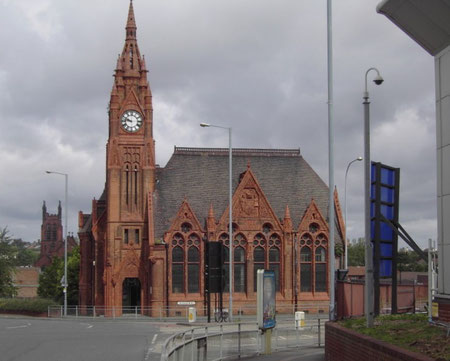
Take a look. Spring Hill Library designed by the Birmingham architects Martin & Chamberlain in 1893 is built in red-brick and terracotta in elaborate Victorian gothic and is Grade II* Listed. There is a tall clock tower, good detailed red terracotta work including prominent city coats-of-arms in relief, many beasts and curly bits. It is a fine example of a Victorian Birmingham public building standing rather solitary since the area was developed in the late 1960s.
Also looking out of place is on George Street West is the Church of St Peter, a large brick building with stone dressings and a west tower by Birmingham architect F B Osborn in a rather pointed perpendicular style, consecrated 1902. These buildings are the only physical evidence of a Victorian past.
The poor housing of whole area was demolished and rebuilt during the 1960s. Some of that rebuilding did not stand the test of time and was again rebuilt at the end of the 20th century.
For Spring Hill College see Wake Green.
William Dargue 07.03.09